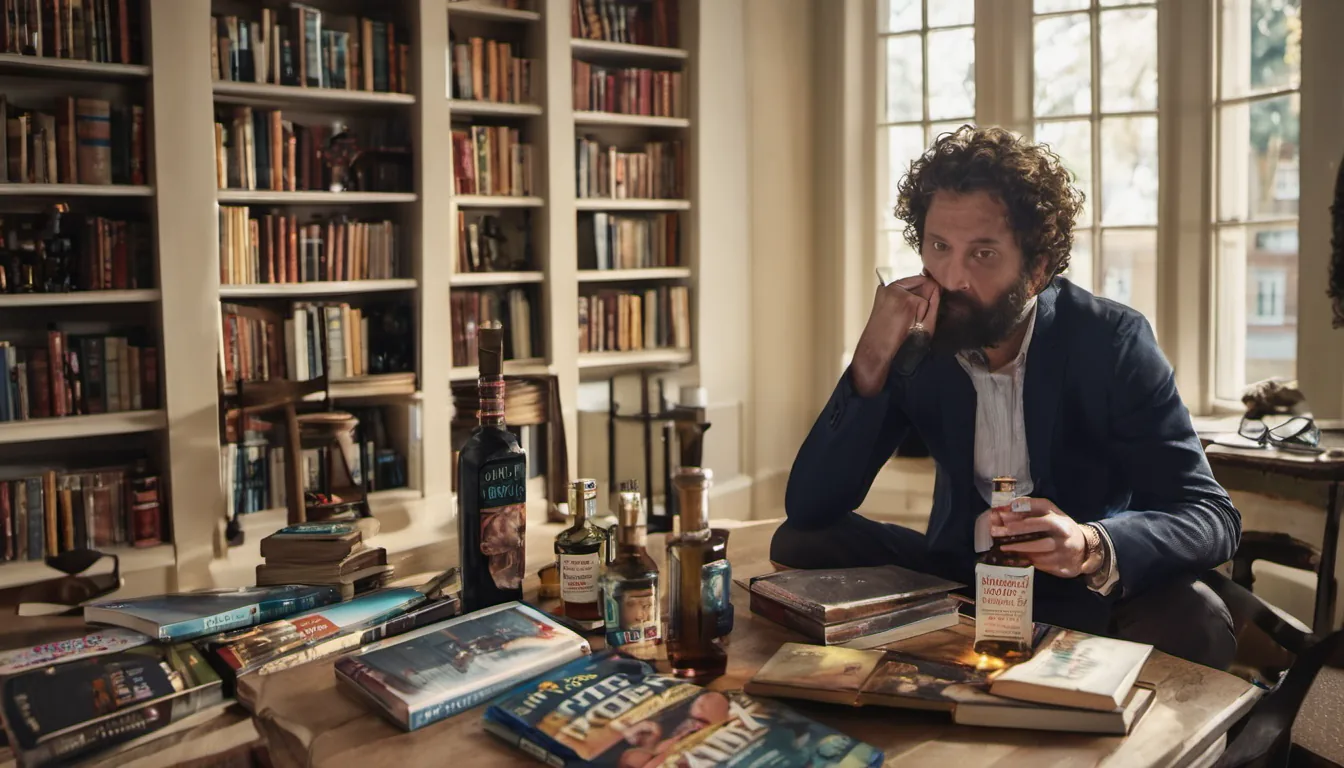
My Home Library vs. the Hangover: 3,500 Years of Bad Cures
Dog hair for a god's headache, Korean soup delivered at dawn, a Romanian Devil with goat's blood, and what medicine actually says
Some time in the second millennium BC, in the city of Ugarit on the Syrian coast, a scribe wrote down a story in which the god Ilu goes on a drinking binge. The story ends with a remedy for the god’s hangover: a salve for the forehead, made of dog hair, part of a plant nobody can identify any more, and olive oil. It is the oldest known link between “hair of the dog” and a night out. So the first hangover cure on record was for a god, and it involved rubbing dog hair on his forehead.
I asked my library a simple question: what is a hangover, and what have people done about it? The library is about 72,000 works plus an offline reference shelf of encyclopedias and dictionaries, and it all sits on one machine in my house. It answered with dog hair, Korean soup delivered by night, a Romanian Devil with goat’s blood, and a medical review that boils down to: sorry, nothing works.
Contents · 9 sections
In one minute #
- A hangover is what your body goes through while it cleans up after alcohol. It peaks when your blood alcohol gets back to about zero.
- The cause is not fully understood. Acetaldehyde, inflammation, bad sleep, low blood sugar, extra chemicals in dark drinks and some dehydration all play a part. Water alone doesn’t fix it.
- Almost every culture I looked at has a cure, mostly soups, pickles or more alcohol. None has good scientific proof.
- “Hair of the dog” only moves the hangover to later, and doctors see the habit as a warning sign.
- What works: drinking less, eating, sipping water between drinks, sleeping, and waiting. Your liver clears about 8 grams of alcohol per hour, and you can’t hurry it.
What’s actually going on in there #
Your liver breaks down ethanol in two steps. An enzyme turns it into acetaldehyde, which is somewhere between 10 and 30 times more toxic than the alcohol you drank. A second enzyme then turns acetaldehyde into acetate, which is basically vinegar. In about half of all East Asians that second step is slow, so acetaldehyde builds up and causes the well-known red “flush”. Their bodies send the bill straight away.
Beyond that, the theories compete:
- Dehydration. Alcohol makes you pee, so you get thirsty, dizzy and dry-mouthed. Studies find that it plays a smaller part than most people think. Water helps the thirst, not the hangover.
- Your immune system. Of everything researchers have measured, this has the strongest link to how bad the hangover is. After a heavy night, the blood carries more of the signals the body uses to fight infection. In other words, you have a small, self-inflicted flu.
- Sleep. Alcohol knocks you out and then ruins the sleep that follows. On hangover mornings the two biggest complaints are drowsiness and a slow brain.
- Low blood sugar. It does drop, but nobody has shown how much that matters.
- Acetate. In one rat study, acetate alone was enough to give the rats hangover-style headaches. Caffeine stopped the headaches.
- Congeners. These are the other chemicals made during fermentation and ageing. They give drinks their flavour, and they may make the hangover worse. Bourbon has about 37 times more of them than vodka. All four studies my encyclopedia cites on the question agreed that darker drinks give worse hangovers. One ranking, from mildest to worst, put brandy at the very bottom, just after red wine.
The strangest part: about a quarter of heavy drinkers say they have never had a hangover. Genes probably play a part. The cause of “hangxiety”, the morning-after dread that hits roughly 12% of people, has not been found.
A world tour of the morning after #
Antiquity: cabbage versus the vine #
The ancient Greeks believed cabbage and grapevines were natural enemies. Plant cabbage near a vineyard and the grapes would pick up its smell. So, the logic went, eat cabbage and the wine can’t beat you. The physician Androcydes is said to have recommended cabbage against wine. According to Pliny the Elder, the same Androcydes also wrote to Alexander the Great, begging him to drink less. Alexander did not take the advice.
The Greeks also named a gemstone after the same hope. Amethystos means “not drunk”. Greeks and Romans wore amethyst, or drank from amethyst cups, to keep the wine from taking hold.
Pliny also passed on the medical idea behind “hair of the dog”. If a mad dog bit you, you put ash from that dog’s hair into the wound. The English phrase only moved from dog bites to drinking much later.
Korea: soup by night, maybe a bribe #
The Korean word haejangguk means “soup to chase a hangover”. A Chinese phrasebook from the Goryeo dynasty (918–1392) mentions a “soup to get sober” made of meat, noodles and scallions, which is more or less the same dish served today. A 19th-century poetry collection describes “dawn bell soup”. Cooks made it from cabbage hearts, bean sprouts, short ribs, sea cucumber and abalone, simmered it all day, packed it into warm clay pots wrapped in cotton, and carried it to Seoul through the night. High officials got their pot when the dawn bell rang. Nobody is sure whether this was the first hangover delivery service or a bribe.
Some versions today contain slices of congealed ox blood. South Korea’s hangover-product market, which sells drinks, pills and jellies, was worth about 250 billion won (US$213 million) in 2019.
The Balkans and Romania: tripe, sour, at midnight #
In Turkey, tripe soup has been the drink-session finisher since the Ottoman 1800s, after an evening of rakı. It is still served right after midnight on New Year’s Eve. The same soup spread across the Balkans, and in Romania it became ciorbă de burtă: soured with vinegar or lemon, finished with sour cream and egg yolk, and served with a garlic sauce you could strip paint with. Radu Anton Roman wrote that it “looks like it is made for drunk coachmen” while having “the most sophisticated and pretentious mode of preparation in all Romanian cuisine.”
The Romanian word mahmureală comes from Ottoman Turkish mahmur, from Arabic makhmūr, “intoxicated”, which comes from khamr, “wine”. A Romanian hangover is, at root, an Arabic word for wine.
Romanian folklore also explains drunk behaviour. In one version of the Noah story, the Devil helps Noah plant the first vine. He waters its roots with the blood of a goat, then a lion, then a pig. That’s why a little wine makes a man “merry”, frisking about like a young goat. You can probably guess which glass belongs to the pig.
Russia, Poland and friends: the pickle school #
Russian has a special word, opokhmelka, for drinking the next day to undo the day before. The sour, salty soup solyanka is full of pickles and is nicknamed “hangover soup”. Poles knock out a wedge with a wedge (klin klinem); Romanians, Italians and Spaniards pull a nail with a nail (cui pe cui se scoate).
Everyone else #
- Japan: a hangover is futsukayoi, literally a “two-day drunk”, a word recorded since about 1500. The morning drink is mukaezake, “alcohol to greet the day”.
- China: the morning drink is huíhúnjiǔ, “the drink that brings back your soul”.
- Denmark: a hangover is tømmermænd, “carpenters”, after the hammering in your head.
- Germany: Kater means tomcat, but in this sense it’s probably a joke on Katarrh, “catarrh”, which is why German hangover pictures are full of cats.
- France: an older expression is mal aux cheveux, “sore hair”. Even your hair hurts.
- Puerto Rico: the morning drink is called “killing the mouse”. In Estonia it is “head repair”; in Iceland, “the straightener”.
The West, in cocktails #
According to the story, the prairie oyster was introduced at the 1878 Paris World Exposition: a raw egg yolk swallowed whole with Worcestershire sauce, hot sauce, salt and pepper. In 1916 Jeeves fixes Bertie Wooster with one: “The raw egg makes it nutritious. The red pepper gives it its bite.” By 1938 the Ritz-Carlton was serving Coca-Cola mixed with milk. Hemingway preferred tomato juice and beer. A Paris bar says the Bloody Mary was born there around 1921 under the name “Bucket of Blood”. A 1957 American folklore survey found three favourite cures: fried food, tomato juice and sex.
What the religions said (mostly: don’t get there) #
- Hinduism. A Rigveda verse describes drunks as people who “lose their intellect, talk rubbish, get naked and fight with each other”. Thousands of years later, it is still a fair account of a stag party.
- Islam. The Quran says of wine and gambling that there is “great sin and benefit for people. But their sin is greater than their benefit”. Alcohol is forbidden.
- Buddhism. The fifth precept asks followers to avoid intoxicants that cause heedlessness. In one discourse, drinking comes first in the Buddha’s list of six ways to waste your money.
- Judaism and Christianity. Wine is part of the sacred rites, and drunkenness is warned against. Noah’s first vintage in Genesis is the original cautionary tale. A medieval Jewish text says “there is no greater sin than drunkenness.”
None of the texts I read offers a recipe for the morning after. They’d prefer the morning after never happened.
“Hair of the dog”: a loan with interest #
It does feel like it works, and there are two theories why. One treats a hangover as mild withdrawal, which more alcohol calms for a while. The other involves methanol, present in small amounts in most drinks. Your liver deals with ethanol first and leaves the methanol waiting. Methanol breaks down into nasty formaldehyde and formic acid, on a timetable that matches when symptoms show up. Another drink sends the methanol back to the end of the queue.
Either way, you aren’t fixing anything, you’re postponing it. People who drink to cure a hangover are more likely to have drinking problems now or later. A morning drink is a loan with steep interest.
What medicine actually supports (spoiler: very little) #
A 2005 British Medical Journal review of eight randomised trials, from prescription drugs to prickly pear, artichoke, yeast and plain sugar, concluded: “No compelling evidence exists to suggest that any conventional or complementary intervention is effective for preventing or treating alcohol hangover.” The US National Institute on Alcohol Abuse and Alcoholism is just as direct: “only time can help.”
The evidence, by level (none of this is dosing advice):
- Water: eases thirst, dry mouth and dizziness. Sipped between drinks, it also slows you down.
- Anti-inflammatory painkillers: one small 1983 study of 30 people found that an anti-inflammatory drug (tolfenamic acid) eased headache and nausea but not tiredness. That fits the immune theory, but these drugs raise the risk of stomach bleeding when you drink.
- Dihydromyricetin (DHM): from the Japanese raisin tree, a traditional hangover herb in China, Japan and Korea, now sold widely. One study found it had no effect on how the body processes alcohol. Rat results are interesting; human proof is missing.
- N-acetylcysteine: gets mentioned a lot. The study usually cited was done on zebrafish.
- Kudzu: the traditional remedy uses the flower, while Western sellers often use the root. One review warns that the root may be harmful, because it blocks the enzyme that clears acetaldehyde.
- Pyritinol (a synthetic relative of vitamin B6): helped in one 1973 study, at hundreds of times the normal daily amount. It has since been linked to liver and pancreas damage.
- Raw eggs: contain cysteine, which helps break down acetaldehyde in theory. Nobody has shown that eating eggs helps a hangover.
- Activated charcoal: listed as ineffective, and not useful for alcohol poisoning either.
SAFETY: when it’s not a hangover
If someone was drinking heavily and now shows any of these signs, it may be alcohol poisoning, and that is an emergency:
- confusion, or they can’t be woken
- vomiting while drowsy or unresponsive (they can choke)
- slow breathing (fewer than 8 breaths a minute) or irregular breathing
- seizures
- blue, grey or pale skin, or a low body temperature
Call 112 (free from almost any mobile phone in Europe, even a locked one). Don’t leave them alone. Lay them on their side in the recovery position and keep them warm. Don’t count on cold showers or coffee.
Don’t take paracetamol (acetaminophen) during or after heavy drinking. Alcohol and paracetamol together can damage the liver. Anti-inflammatory painkillers such as aspirin or ibuprofen raise the risk of stomach bleeding when combined with alcohol.
Don’t drive the morning after. Hangovers impair you, and the effects can last a full 24 hours after heavy drinking.
Myths scoreboard #
| Remedy | Verdict |
|---|---|
| Drinking less, eating, sleeping, water between rounds | Works (the only thing that really does) |
| Water the next morning | Sort of: helps the thirst and the headache, not the whole hangover |
| Anti-inflammatory painkillers | Sort of: small evidence for headache, real stomach risk |
| Tripe soup, haejangguk, pickle brine, solyanka | Sort of: comforting food and salt, no proof they cure anything |
| Prairie oyster, raw eggs | No: theory only |
| “Beer before wine and you’ll feel fine” | No: a 2019 trial found the order makes no difference |
| Coffee, a cold shower | No: you’re just a more awake person with a hangover |
| Dog hair on your forehead (Ugarit) | No, but respect for being first |
| Hair of the dog | Please don’t: it postpones the hangover and is linked to problem drinking |
| Sauna or steam bath to “sweat it out” | Please don’t: heat plus alcohol raises the risk of dangerous heart rhythms |
| Kudzu root supplements | Please don’t: may block the very enzyme you need |
| Paracetamol and a hangover | Please don’t: risk to the liver |
Questions people ask me #
Does mixing drinks make it worse? #
Not by itself. When researchers kept blood alcohol the same, the order and the mix didn’t change how bad the hangover was. Dark drinks really are worse than clear ones, because of the congeners.
Why do hangovers get worse with age? #
Many people say they do, but research hasn’t settled it. One thing that has been measured: older people have fewer of the very heavy nights that cause hangovers in the first place.
Why do I get one when my friend doesn’t? #
Genes and sex play a part. At the same number of drinks, women usually reach a higher blood alcohol level. At the same blood alcohol level, men and women get about the same hangover. Smoking while drinking makes it worse, and so does poor sleep.
How much does all this cost? #
In Finland, a country of about 5 million people, more than 1 million workdays are lost to hangovers every year. In the US, about 9% of the workforce has gone to work hungover.
Where all this came from #
Everything here came from books and offline archives on one machine in my house: a library of about 72,000 works and an offline shelf of encyclopedias, dictionaries and old texts. There was no cloud search and no online lookup. For every fact I wrote down where it came from, and I dropped the famous “facts” I couldn’t confirm. Mongolian pickled sheep’s eyes and a lime rubbed under the armpit in Puerto Rico didn’t make it in. They may be real, but my shelves couldn’t vouch for them.
The source list is in a separate file. Write to me at lisneanucristian@shuffle-on.com and I’ll send it.
This is the first post in a series I’m calling Ask my library: ordinary questions, answered only from what sits on that one machine. If you have a question you’ve always wondered about, send it the same way. The best ones get their own post.
And if you’re reading this with a headache: drink some water and go back to bed. Nobody has found a better cure.